Hey there Yogis!
There is so much to admire and explore on our planet.
Lush green forests.
Breathtaking waterfalls.
Rugged yet peaceful mountains.
The beauty of Earth surrounds us constantly.
Yet now, more than ever, we must find ways to preserve it for future generations.
There is something bittersweet about the fact that so many people around the world are fighting to ensure that basic human rights are respected — regardless of gender, sexuality, race, or religion — while at the same time, the planet itself is at risk.
We cannot allow ourselves to fall into apathy.
Each of us can take steps toward living more sustainably.
Fortunately, there is a day dedicated not only to appreciating the Earth's beauty, but also to raising awareness about the importance of protecting its natural resources.
Earth Day.
What is Earth Day and why do we celebrate it?
The year 2023 marked 53 years since the first Earth Day.
Environmental activism in the 1960s inspired Wisconsin Senator Gaylord Nelson to create a national event that would unite the environmental movement.
With the support of Denis Hayes, a graduate student at Harvard University, the first Earth Day was organized on April 22, 1970.
The goal was to educate people about environmental issues and the importance of conservation.
In 1990, Hayes helped expand Earth Day into a global movement, with more than 200 million participants across 140 countries.
Today, Earth Day brings together individuals, communities, and organizations worldwide to promote awareness and action regarding environmental challenges such as climate change, sustainability, and renewable energy.
The Earth Day Network now collaborates with more than 20,000 partners in 190 countries, supporting environmental initiatives throughout the entire year.
Earth Day is every day.
Source: National Geographic.
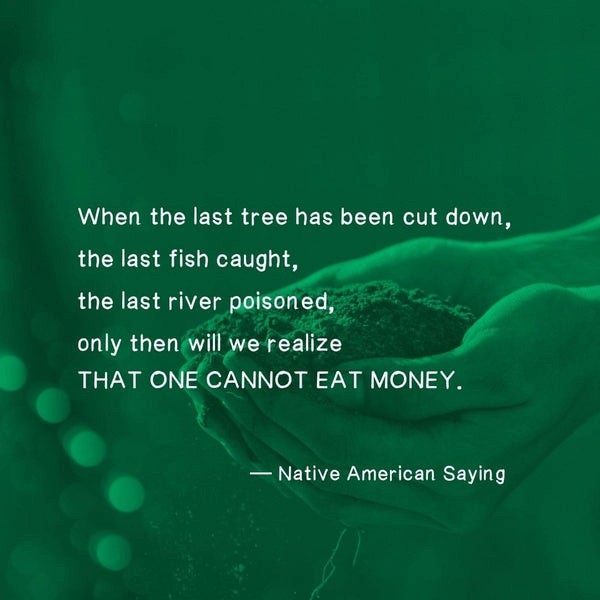
I. A Native American saying
"When the last tree has been cut down,
the last fish caught,
the last river poisoned,
only then will we realize that one cannot eat money."
II. Mountain Pose
Tadasana
Tadasana, or Mountain Pose, is considered the foundation of many yoga postures.
It invites you to become centered and grounded as you move through your practice.
In this posture, you stand upright with your feet parallel and your arms resting at your sides, palms facing forward.
Although it may appear simple, Mountain Pose contains the principles of alignment that support many other yoga postures.
Tadasana encourages proper posture by aligning the shoulders, hips, knees, and ankles.
It can also help counteract the effects of long hours sitting at a desk, reminding the body how it feels to lengthen the spine and release tension in the shoulders.
Through this pose, the mind can become quieter as awareness returns to the body.
Mountain Pose invites stability, balance, and connection to the ground beneath us.
How to practice Mountain Pose.
Source: Yoga Journal.
III. Okja | Movie
Okja offers a powerful reflection on the environmental impact of industrial meat production.
The story follows Mija, a young girl who lives in the mountains of South Korea with her grandfather and their beloved companion, Okja — a genetically engineered animal.
Their peaceful life is disrupted when a corporation seeks to use Okja as part of a large-scale food production system.
Motivated by love and loyalty, Mija embarks on a journey to protect her friend.
Director Bong Joon-ho explores themes related to consumer culture, environmental ethics, and the relationship between humans and animals.
The film invites viewers to reflect on how modern production systems influence the way we interact with nature and other living beings.
Watch the trailer.
We will get back to you shortly, Yogis.
Xoxo
Treelance Yoga