Hey there Yogis!
In our last post, we explored Yamas and Niyamas, the first two limbs of the Yoga Sutras, used as guidelines in yogic philosophy.
We defined Yamas as restraints and Niyamas as observances, and we reflected on one of the yamas: Ahimsa, the practice of living in non-violence.
Today, we would like to go deeper into one of the niyamas: Santosha.
Santosha invites us to move beyond non-violence and into contentment, encouraging us to fall in love with our own life.
It teaches us to take refuge in a calm inner center, opening the heart in gratitude for what we already have.
Santosha asks us to embrace what life is offering at this exact moment.
Practicing gratitude protects us from our own pettiness and helps keep us grounded in the joy and abundance already present in our lives.
Arriving at contentment can sometimes feel confusing. The path is not always clear, and we cannot simply “force” our way into it.
Instead, it is a process of softening our expectations so that we can gently embrace life as it is.
Are you able to practice gratitude?
Can you accept what is?
Can you fall in love with your own life?
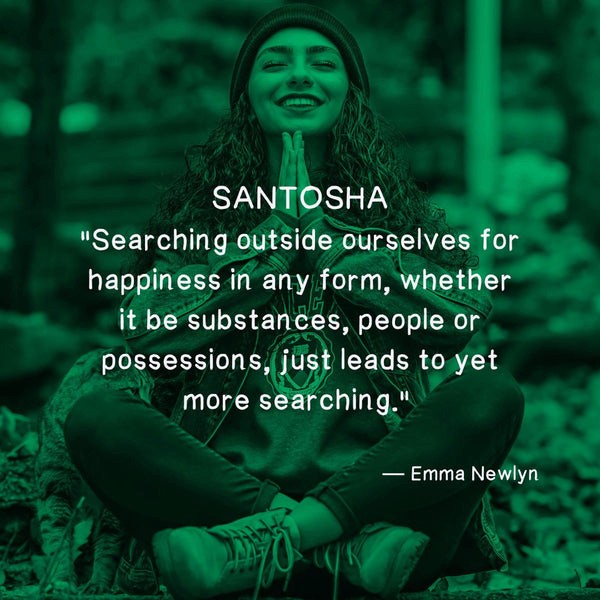
I. A quote by Emma Newlyn
Searching outside ourselves for happiness — whether in substances, people, or possessions — often leads to endless seeking.
Everything around us, including our experiences and emotions, is constantly changing because they are part of prakriti, or nature.
However, our true Self is unchanging.
Who we truly are has always been enough.
We often postpone being ourselves until we complete an endless list of things we believe will make us “better.”
But the truth is, you will always be you.
You can continue disregarding your uniqueness while chasing an ideal version of yourself, or you can begin appreciating and loving who you already are.
Authentically and unapologetically you.
Content with who you are and what you have, because no one else can offer the world what you can.
To move closer to peace, Santosha becomes one of the most meaningful practices we can return to again and again.
We cannot fully love, trust, give, or live if we do not first cultivate enough love within ourselves.
From EkhartYoga.
II. Bow Pose — Dhanurasana
Dhanurasana comes from the Sanskrit word for bow, as the body forms the shape of an archer’s bow in this posture.
This heart-opening backbend stretches the hip flexors and hamstrings while strengthening the muscles of the back.
It helps improve posture by opening the chest and shoulders, counteracting the effects of long hours spent sitting or working at a computer.
Arching the back and reaching for the feet also requires surrender and trust in the process.
Through this, the pose can help us release attachment to expectations, cultivating acceptance and openness in life.
Like many backbends, Bow Pose energizes the body and stimulates the adrenal glands, which may help reduce fatigue.
It also increases blood circulation to the digestive organs.
How to practice Dhanurasana.
III. Penguin Bloom | Film
In Penguin Bloom, Naomi Watts portrays Sam Bloom, an active and adventurous woman whose life changes dramatically after an accident leaves her paralyzed from the waist down.
The film explores her emotional struggles, her feelings of loss, and the challenge of adapting to a completely new reality.
A turning point occurs when an injured magpie chick named Penguin enters her life.
Through caring for the small bird and witnessing its growth, Sam and her family rediscover connection, meaning, and hope.
The film reminds us that life does not always unfold according to our plans, and unexpected challenges may appear.
However, like Sam Bloom, we can cultivate acceptance and contentment despite difficult circumstances.
Through this process, we may rediscover beauty in simple moments and deepen our appreciation for the relationships that give meaning to our lives.
Watch the trailer here.
Thank you for reading, and please feel free to share your thoughts.
We love hearing from you!
Xoxo
Treelance Yoga